
What is the best time to post on Instagram in Australia
Current Instagram posting benchmarks, why they disagree, and how to find the best time for your own audience.
Best Time to Post on Instagram
There is a satisfying version of this article where we give you seven times, you copy them into the content calendar and nobody ever has to think about the question again.
The current research is less convenient. Large 2026 studies disagree about the strongest Instagram posting windows because they analyse different account samples, periods, markets, content mixes and definitions of performance. A global average can be statistically solid and still describe your account badly.
There is no single best time to post on Instagram for every account. Current 2026 benchmarks point to different strong windows, so use them as a starting point. Check your own audience activity and past performance, test two or three realistic posting windows, and let the metric that matters to your business determine the schedule.
Often, the bigger problem is not a lack of benchmark data. It is that the schedule was never really chosen. Nine o’clock became the posting time because that is when somebody starts work; lunch became the default because that is when the content manager remembers; 5pm has sat in the calendar for two years without anyone checking whether it still makes sense. Internal convenience can gradually turn into something that looks like audience strategy.
What is the best time to post on Instagram in 2026?
If you have little account data and need somewhere sensible to begin, current benchmarks give you several credible windows to test.
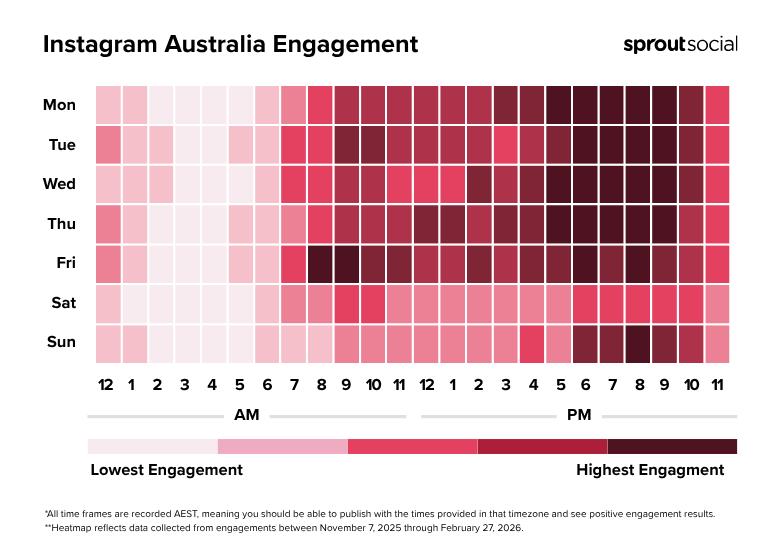
Sprout Social’s Australian 2026 report contains a dedicated Instagram heatmap and identifies 5–10pm AEST from Monday to Thursday as the strongest sustained window. The qualification matters: Sprout’s disclosed Australian dataset contains more than 68 million engagements across Facebook, Instagram, LinkedIn, TikTok, X and Pinterest, and the report does not disclose the Instagram-only sample size. Use the Instagram heatmap as an Australian benchmark hypothesis, not proof that 7pm is best for your brand. Sprout Social’s Australian 2026 study
Buffer reaches a different conclusion. Its July 2026 study analysed 9.6 million Instagram posts published between January 2024 and December 2025 and compared median engagement rate. Its strongest individual slots were Thursday at 9am, Wednesday at 12pm and Wednesday at 6pm, with times normalised so they apply in the reader’s local timezone. Buffer’s 9.6-million-post Instagram study
Later analysed more than six million Instagram feed posts and found something different again: 5am in the audience’s local timezone produced its strongest overall engagement. Later’s 2026 Instagram timing study
For an Australian brand starting without much historical data, an evening window based on Sprout and a midweek lunchtime or evening window based on Buffer are both reasonable hypotheses. Once the account has enough history, your own evidence should begin to outweigh the averages.
How to find your own best time to post
Instagram provides Insights for professional accounts so businesses and creators can examine account and content performance. The interface changes often enough that we would not build this article around a brittle sequence of menu instructions. Instagram Help Centre: About Instagram Insights
The principle is simpler: use the audience and performance information available in your current Professional Dashboard, then compare it with what happened when you actually published.
Later’s current 2026 guidance similarly recommends using Instagram’s Professional Dashboard or account-specific analytics rather than relying solely on generic timing benchmarks. Later’s Instagram timing guidance
Audience activity does not automatically identify the winning publishing time. If your data suggests followers are frequently active around 7pm, that makes 7pm a sensible test window. It does not prove that 7pm will produce the most saves, website visits or enquiries.
Geography changes the problem as well. A Melbourne brand whose audience is overwhelmingly in Victoria has a relatively simple scheduling problem. A brand with substantial audiences in Australia, Europe and North America may need separate publishing windows or may deliberately prioritise one market for a particular campaign.
Be precise with Australian timezones. Sprout reports its Australian benchmark in AEST. In Victoria, daylight saving begins in October and ends in April, moving clocks forward and then back by an hour. A result explicitly labelled AEST should therefore not silently be treated as the same Melbourne clock time throughout the year. Business Victoria: daylight saving
What the big Instagram benchmark studies actually say
Buffer, July 2026. Buffer analysed 9.6 million Instagram posts published between January 2024 and December 2025, using median engagement rate to compare performance. Its strongest individual windows were Thursday at 9am, Wednesday at 12pm and Wednesday at 6pm, with times normalised to local timezone. The dataset is Instagram-specific and substantial, but it still combines many different account types, industries and audiences. Read the Buffer study.
Sprout Social, Australia, March 2026. Sprout’s Australian report identifies roughly 5–10pm AEST from Monday to Thursday as a strong Instagram window. The report includes a separate Instagram heatmap, but its disclosed Australian dataset of more than 68 million engagements covers six social networks. Sprout does not publish the Instagram-only Australian sample size, so this is best treated as a useful Australian benchmark rather than a rule for individual accounts. Read the Sprout Social study.
Later, April 2026. Later analysed more than six million Instagram feed posts and found 5am in the audience’s local timezone to be its strongest overall posting time. Its underlying observation period ran from January to October 2024, so the data is older than the publication date and its methodology differs materially from Buffer’s. Read the Later study.
The disagreement is useful. These studies are looking at different samples, periods and definitions of performance, so we should not expect them to produce one universal answer. Use them to identify sensible windows to test, then let your own account data decide which ones are worth keeping.
Why your best time may be different
Suppose a benchmark says Wednesday at noon performs well.
It still does not know whether your audience is concentrated in Melbourne or Los Angeles, whether you sell enterprise software or sneakers, what your followers’ routines look like, or whether the post is supposed to create awareness, saves or website action.
Even the word best needs a definition.
A 6pm post might collect more likes. A lunchtime post might produce more saves. Another window might send more people to the profile or website. If the commercial objective is website activity, declaring 6pm the winner because it generated three additional likes answers the wrong question.
Posting-time optimisation should therefore follow the objective rather than defaulting to engagement. One unusually successful post should not rewrite the schedule either: the idea may have been stronger, the subject more timely or the creative substantially better. Look for repeated patterns before attributing the difference to time of day.
Does the best time change for Reels, feed posts and Stories?
Be cautious with precise format-specific charts.
Buffer explicitly states that its 9.6-million-post timing analysis combined Instagram post types rather than segmenting the core timing dataset by format. Its discussion of Reel and carousel timing therefore sits around the broader dataset rather than representing a separate 9.6-million-Reel study. Buffer’s methodology and format discussion
Later does provide separate Reel evidence. It reports analysing more than 975,000 Instagram Reels, finding 12am as the strongest overall time and Monday as the strongest day. Later’s Reel timing data
That is evidence that format can matter, but it is not a reason to turn “12am Monday” into a universal Reel rule. If your own results suggest Reels behave differently from carousels or static posts, separate those tests.
How to test your Instagram posting times
You do not need a laboratory experiment. You need enough discipline to stop changing every variable at once.
Choose two or three plausible windows based on the available evidence. For an Australian account, that might mean testing a midday window against one or two evening windows.
Run multiple posts through each window rather than letting one unusually strong or weak post decide the result. Record the day, time, format and broad topic so obvious differences remain visible. Where possible, compare reasonably similar work rather than a major product launch at midday against a routine filler post in the evening.
Choose the success metric before looking at the result.
If the goal is awareness, reach or views may matter. If the work is designed to be useful or passed around, saves and shares may tell you more. For commercially oriented posts, profile activity, website behaviour or enquiries may be more relevant where attribution supports that interpretation.
Repeat the stronger windows before declaring a winner. If the topic, format, creative and publishing time all change together, you have compared two different pieces of content rather than learnt much about posting time.
Timing cannot fix the post
Posting time deserves some attention because it changes the distribution conditions around the work. It does not determine whether the work deserves attention once somebody sees it.
A generic Reel does not become distinctive at 6pm, and a weak idea does not become useful because it went live during the darkest cell in a benchmark heatmap.
Timing is worth testing, but it is a small distribution variable—not a substitute for work people want to see. Use benchmarks to remove some guesswork, use account-level evidence to narrow the windows, then judge the schedule against the outcome you genuinely care about.
Our social media work covers the thinking, creative and execution around what gets published as well as when it goes live.

